

The bugs, the incidents, the “can you look at this,” all come back to the people who built it. AI clears the easy ones in seconds, and the queue looks like it is moving. Then a request that has been waiting a week surfaces, and half the queue turns out to be work nobody ever opened.
I watched this break in a support team for a set of online services, years before AI was in the room, which is why I trust the pattern. Six people, one shared queue, a 24-hour promise. Here is what I saw, and what works.
Where the backlog came from
I called the last ten whose requests had been closed. The message was the same from almost all of them: too slow. Most had waited more than two days. Some waited a full week. Half had never received a reply at all.
Then I shadowed the team. With the team leader, we counted 320 pending requests. Some were over a year old, sitting untouched in a queue nobody opened.
The problem was never the headcount. Each tech pulled work from whichever corner of the queue they happened to know, whenever they thought it was right. Routing rules were broken, so requests landed wherever. The 24-hour target lived in nobody’s eyeline. The team worked in isolation, and no one could say who was handling what. Work was pushed at people who could not see the whole flow, so the oldest, quietest requests simply aged in the dark.
More agents, same backlog
Buried under tickets, every instinct says hire. It fails for one reason. It treats a backlog as a capacity problem, and it isn’t.
Drop a seventh person into a queue nobody can see, picking work in no order, and you get a faster way to bury requests. I have watched a company hire three agents, then three more, then three more. The backlog grew with the team every time. More hands on a push system push harder. They don’t decide what matters.
Set the rate, not the headcount
First, we made the incoming flow visible. One simple table: incoming, waiting, processed, where everyone could see the numbers. We built it with paper, not a tool.
Then the one move that changed everything. We switched the team from push to pull. The team leader became the dispatcher, assigning by expertise and taking the simple cases herself. And we set a rate. We knew the daily volume and the backlog target, so we knew exactly how many requests to clear each day, and each hour, to dig out and stay out.
The rest held that move in place. The 24-hour SLA went on the wall and into her daily language. When the team missed the day’s number, they ran a short problem-solving cycle the next morning instead of moving on. One person called five requesters a day to keep the outside view in the room. Nothing here needed a new tool or another hire.
Three months later
The backlog went from 320 to 92 to 20. A 94% drop, with the same six people.
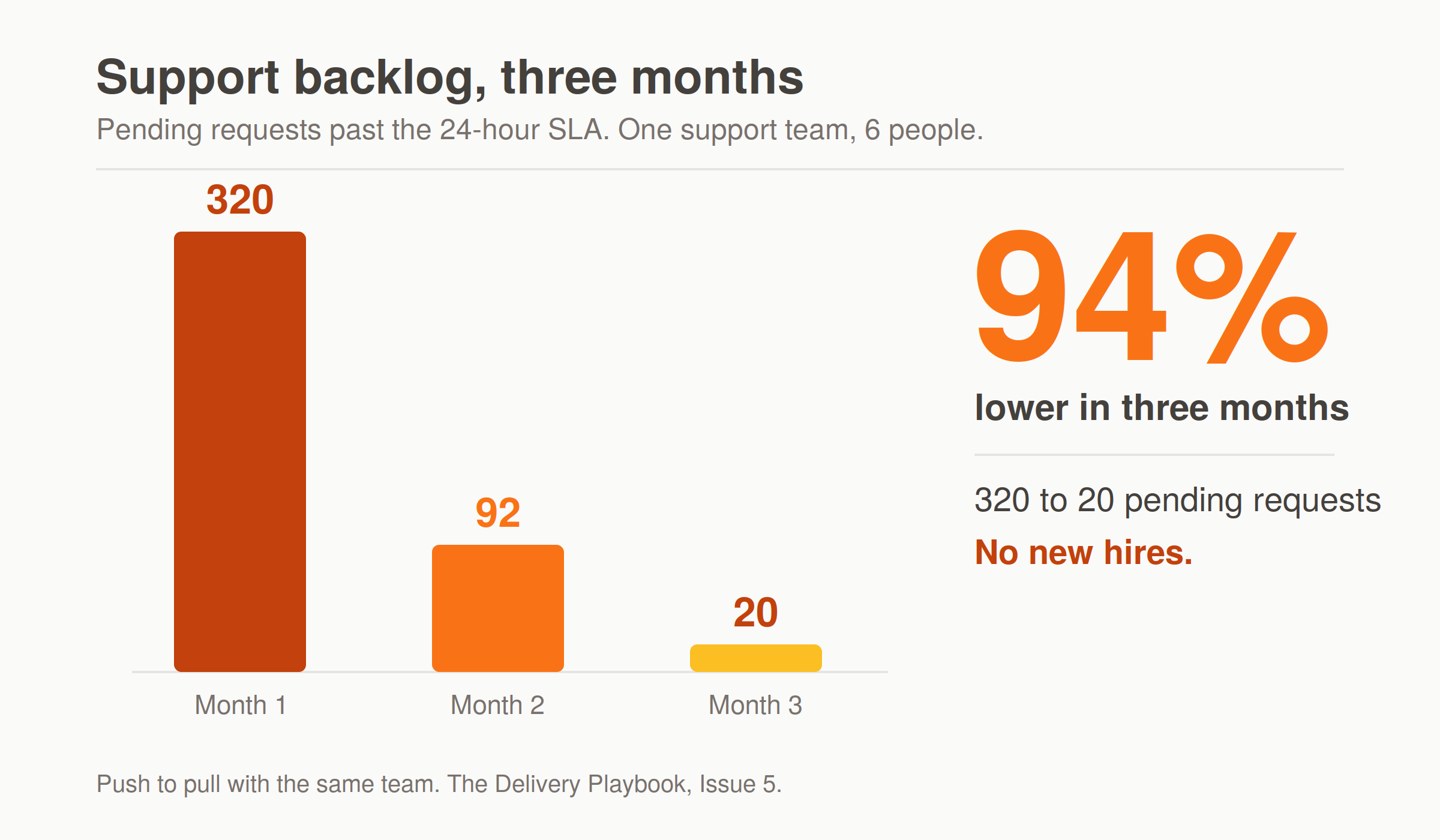
One thing didn’t come for free, and it is the part most case studies cut. Clearing the backlog was the fast part. Holding it is the part no system installs. The pull rate and the morning problem-solving only hold while the team owns them. The day the team stops working the rate, the queue starts refilling. That ownership took longer to build than the number took to move, and it was still being built the day I left.
The pattern
Support teams don’t have a capacity problem. They have a push system that hides what matters and buries the rest.
The same push system runs your bug intake, your incident follow-ups, your on-call queue. Nobody decides what gets worked next, so the oldest, hardest items sink.
That team had no AI in its toolchain. Yours does. AI clears the easy tickets fast, which sounds like relief. What stays in the human queue is the dense, bouncing work AI can’t close, and the tickets it marked “resolved” that quietly come back through another channel. A push system handles that harder mix worse, and now half of it is invisible, hidden behind a dashboard that says the volume dropped. AI didn’t empty the queue. It hid the part that was always the problem.
Pull the work, don’t push it. The backlog follows.
If you suspect your backlog is hiding what matters, start with the Delivery Scorecard. Two minutes, ten questions, and you know where to look first. And when AI tooling is part of the picture, I run a half-day working session with leadership teams on exactly this. Reply to this email, or message me directly on Substack, and I’ll send you the outline.
P.S. The team that hired three agents, then three more, then three more, still had a backlog. The team that set a rate cleared 94% of it with the same six people. Headcount was never the lever.