

AI coding agents have changed how software gets shipped. The old development bottlenecks vanish overnight because an agent can now write a feature or refactor a service in seconds. But that rapid execution exposes a whole new class of problems.
The new code runs successfully in the developer’s environment. The automated pipeline runs tests, linting, and build checks. Everything passed. The code gets approved in review. That new feature does exactly what was asked.
The problem is that what was asked was wrong, or was vague enough that nobody realized it until it hit production.
A miscommunication like this is nothing new in software delivery, but slowness used to protect us from it.
Friction Was Our Quality Control
A few months ago, when writing code took time, a vague spec would have run into natural resistance. Engineers asked questions, pushed back, or simply stalled until things were cleared up.
Right now, AI agents remove that hesitation completely. They take a loose prompt and roll out fluent, high-volume code in seconds. The old review checkpoints weren’t really a deliberate quality process; they were just human lag.
When you remove the lag, you expose the underlying intent drift. So wrong assumptions go straight into production. Your AI agents execute flawed logic at scale, and teams end up spending hours reviewing pull requests that solve the wrong problem entirely.
Shift the Review Upstream
I saw this exact pattern years ago. I was running a QA team where 44% of logged defects were not actually defects. They were wrong environments, duplicate reports, or missing specs. Skilled people were spending months inspecting work that should never have entered the queue in the first place.
Once we focused on fixing what reached the team before logging instead of how we inspected the queue, invalid defects dropped from almost half down to a tiny fraction.
The solution for AI agents is identical: review the brief before letting the agent run.
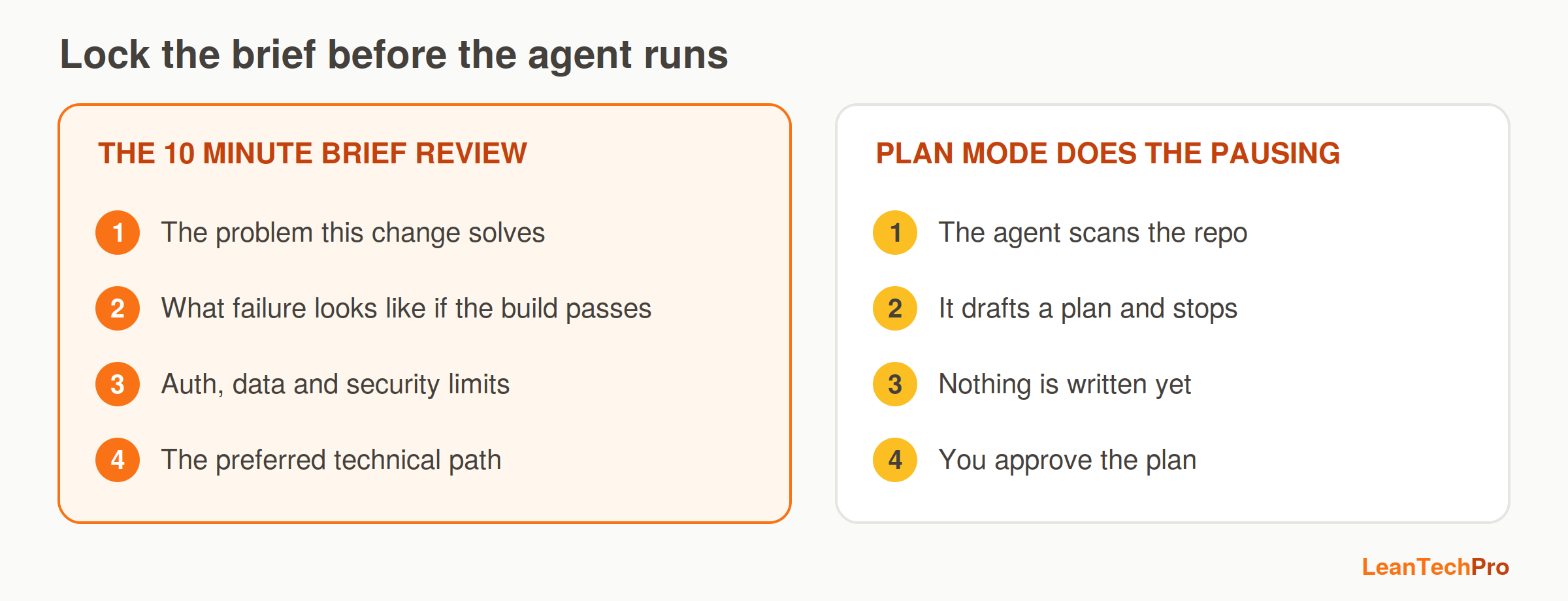
You don’t need a heavy process or a ten-page PRD for this. Take ten minutes to lock down four basic parameters before hitting enter:
What problem this change is actually trying to solve.
What failure looks like, even if the build succeeds.
Non-negotiables like auth limits, data access, and security boundaries.
Preferred technical paths when multiple approaches look plausible.
Getting a second pair of eyes on those points takes almost no effort, but it catches bad assumptions while they still cost nothing.
Plan Mode as a Quality Gate
Modern tools are starting to support this natively. Take Claude Code, for example. Its plan mode scans the repository and drafts a clear brief, then pauses to wait for your approval before writing a single line of code.
A team building data agents in a regulated manufacturing setup recently ran into this. They discovered their failures weren’t coming from bad syntax. Instead, they came from briefs that missed constraints living entirely in someone’s head. Unwritten data validation rules that never made it into a spec.
By treating the plan-approval step as the primary quality gate rather than a formality, they forced those unspoken constraints into the open before generation started.
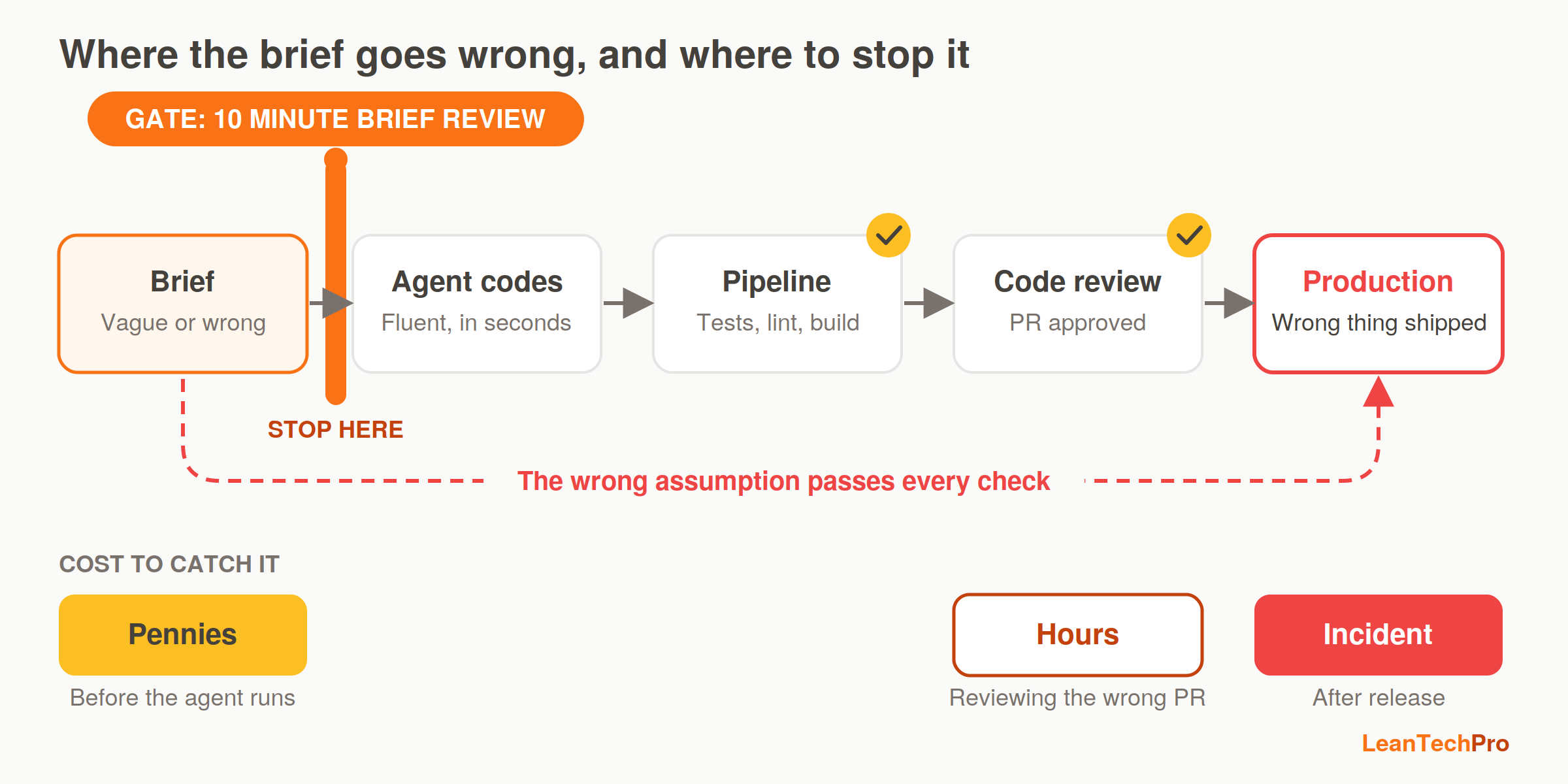
If you skim the plan and only scrutinize the code diff later, you are auditing implementation and hoping the original objective was right.
Once the plan is approved, review the pull request with the brief open beside it. If something still breaks in production, check the transcript to see whether the brief was wrong or if you hit an edge case. Either way, feed that lesson straight into the next prompt.
Catching a mistake in the brief costs pennies compared to catching it in code.