

More work is in flight than a year ago, and every project looks like it is moving. Then a date is missed. Nobody saw it coming.
I watched this break before AI was in the room, which is why I trust the pattern. It is about two project managers I was working with. They were managing nearly 20 BI projects across several continents. The on-time delivery rate was 24%.
When I arrived, I asked one question: where can I see the status of all the projects together? Nobody could point to a single view. Each manager tracked their own work in spreadsheets and email threads. Neither could say how their timelines overlapped or identify a potential delivery issue risk.
Here is the pattern I see, and what works.
The division head was not short on reporting. He had plenty of it. But, status reports arrived late, told different stories depending on who wrote them, and never showed a milestone collision until the damage was done. Client satisfaction sat at 5.5 out of 10, trending down. One of four projects hit its deadline.
The standard response to this situation is more reporting: a new PMO tool, a weekly steering deck, a dashboard pulling from Jira.
It fails for one reason: it treats visibility as a data problem, which it isn’t.
The data existed. It lived in a dozen places, formatted in many different ways; each one true and none of them whole. What was missing was visibility into milestones, dependencies, and potential projects’ collisions. That visibility only appears when everything sits on one surface. These project managers lacked the ability to see a problem before it became a crisis.
So we built an Obeya. It is a room where the whole portfolio lives on the walls. It has three zones. A strategy wall tying every project to the CIO’s targets; a performance dashboard, six handwritten charts updated weekly: on-time delivery, defects per delivery, satisfaction, pace, risk, budget; and a macro planning wall, the whole portfolio on one timeline, planned milestones marked, actual progress in sticky notes.
Building the first version took a two-day workshop, paper, and markers. No software was bought.
The wall paid for itself in the first week. Projects were competing for the same testing resources in the same weeks. Go-lives piled up at quarter end because nobody had ever seen the full picture. One project manager said it out loud: “Now I understand why we keep missing dates.”
The conversations changed too. Before, “are we on track” depended on who you asked. After, the division head stood at the defect chart, saw the trend laid out week by week, and asked a different question: what is causing this?
Visibility alone fixes nothing, though. The wall surfaced the problems; structured problem-solving closed them. Three PDCA cycles ran in that room. One rescued a major go-live that the math said would slip. One fixed a defect-quality problem in testing, after I sat next to a developer and watched him mark a broken PDF export “OK” because the test script only said, “verify PDF export.” One turned a client complaint about a local project into a checklist the team still uses.
Three months later, with the same people in place, on-time delivery increased from 24% to 55%. Defects per delivery dropped from 38 to 19. Client satisfaction climbed from 5.5 to 9.4. Delivery pace tripled, from 9 projects delivered in October to 27 by December.
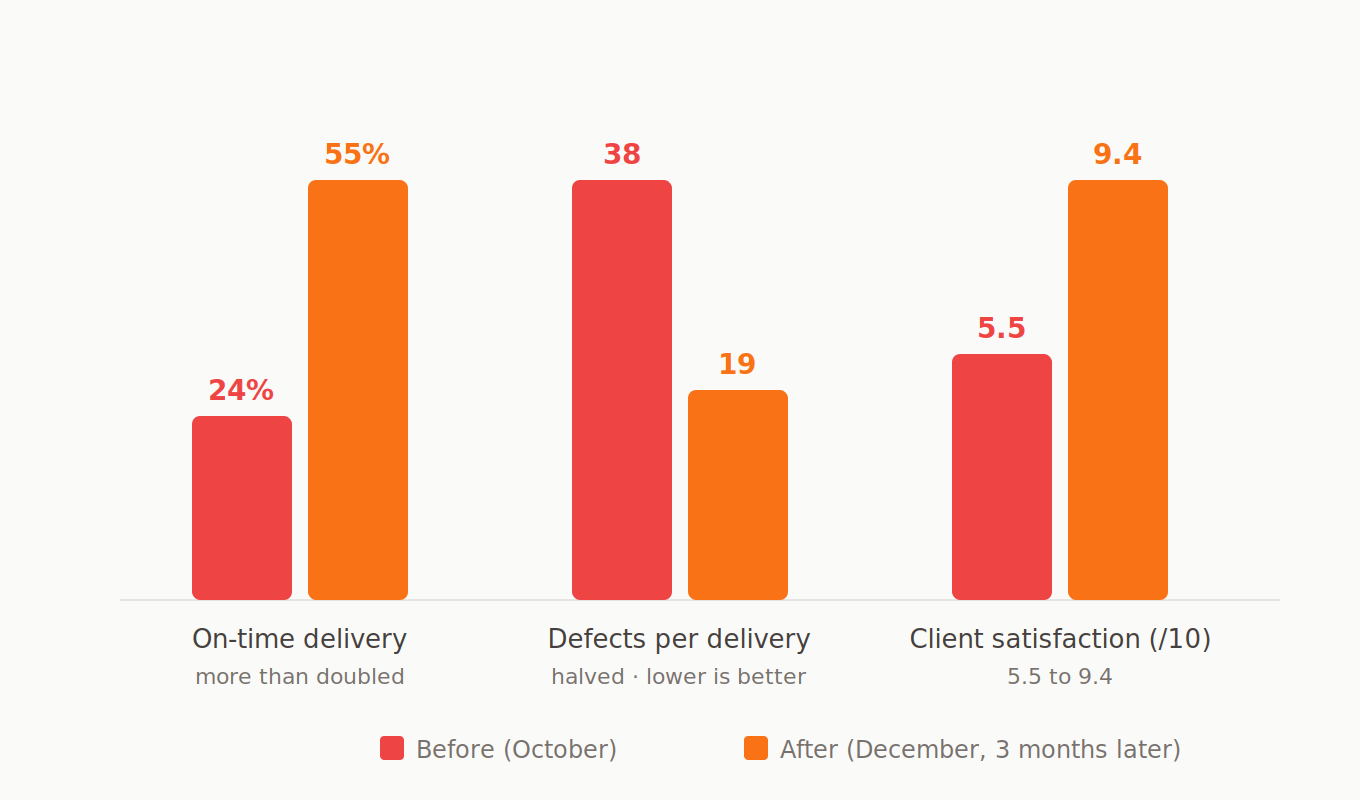
One number on that chart is still a miss. The strategy wall set the on-time target at 60%. The team reached 55. That chart was still red when I left, visible to everyone who walked in every week. I count that as a feature. A system that keeps your remaining gap on the wall beats one that lets you declare victory early.
Those two project managers were good at their jobs. They did not had a single place to see twenty projects at once, so the collisions stayed hidden until a date got bumped.
That team team worked with spreadsheets and emails. If you add AI to a portfolio like that, the only thing that changes is how many projects you have in flight. The collisions are the same; there are just more of them, and they stay invisible until a date is already gone.
The 60% target, that was still red, is a good thing. You probably have more projects running today than that team ever did. I would guess you still have no wall, even digital. Building one takes two days, some paper and a few markers.
The three cycles that produced those numbers are written out in full in the case study.